Rack power density in AI data centers has climbed past what conventional distribution gear was sized for. More current through the same footprint means heavier busway and bigger switchgear. MarketsandMarkets puts the data-center busbar market at $1.38 billion in 2026, then projects $3.01 billion by 2032. AI is the fastest-growing IT load in that forecast, compounding at 18.8% a year.
Copper gets most of the attention, since copper carries the current. Safe power distribution takes more than copper, though. Every conductor in a switchgear lineup needs something holding it in place and keeping it isolated. Electrical insulation handles that job across much of the market, often in the form of GPO-3. Data centers drive most of Monti’s current growth in that work.
What Changes From One GPO-3 Part to the Next
Readers in this market already know the material: a glass-reinforced polyester thermoset that holds up near energized copper. What varies is the part itself, which is what decides the quote and the lead time.
Grade, thickness, geometry and volume all move independently from one job to the next. A spec that leaves any of them loose turns into a revision later.
Six questions close those gaps:
- How much electrical isolation does the part need?
- What mechanical load will it carry?
- How hot will it get, and for how long?
- What dimensions and tolerances apply?
- How complex is the geometry, and how will a shop machine it?
- How many do you need, from prototype through full production?
Answering those up front gets you a cleaner quote and fewer surprises in the first production run.
Monti works in red GPO-3, quoting to your drawing. Sheet thickness covers .031″ through 2.00″, though six sizes move most: .125″, .250″, .375″, .500″, .750″ and 1.00″. Monti also stocks standard angle and channel profiles across a range of thicknesses and leg lengths.
On the print itself, Monti reviews for manufacturability and cost, then suggests changes that lower price or simplify prod
Where GPO-3 Fits Into Electrical Equipment
In a switchgear lineup, GPO-3 goes wherever copper needs holding or separating. Common parts include:
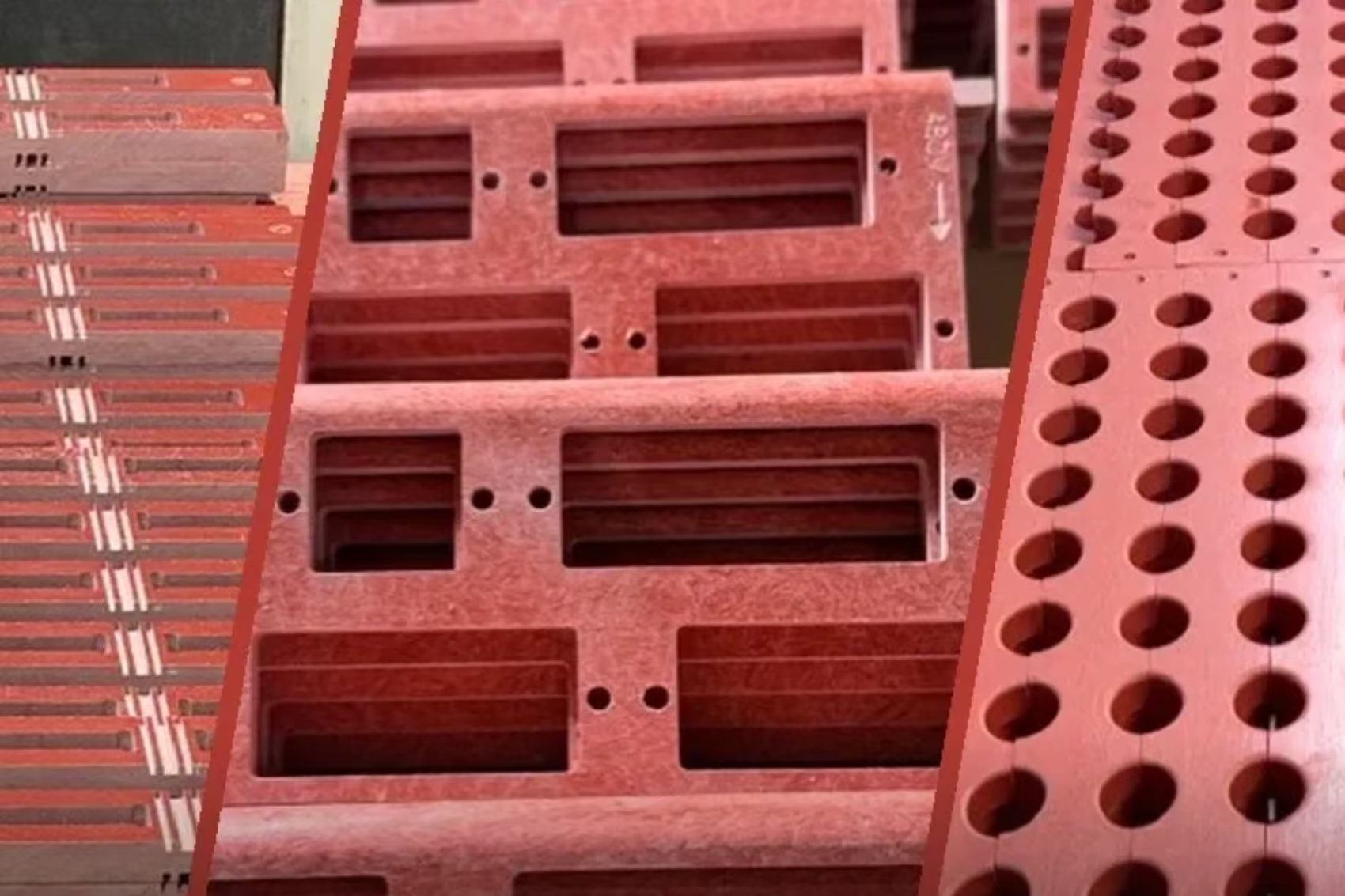
- Bus bar supports and cable supports that carry conductors and hold them in alignment
- Insulating barriers between phases or compartments
- Mounting components and standoffs
- Polycarbonate viewing windows
- Structural insulation inside switchgear and power-distribution assemblies
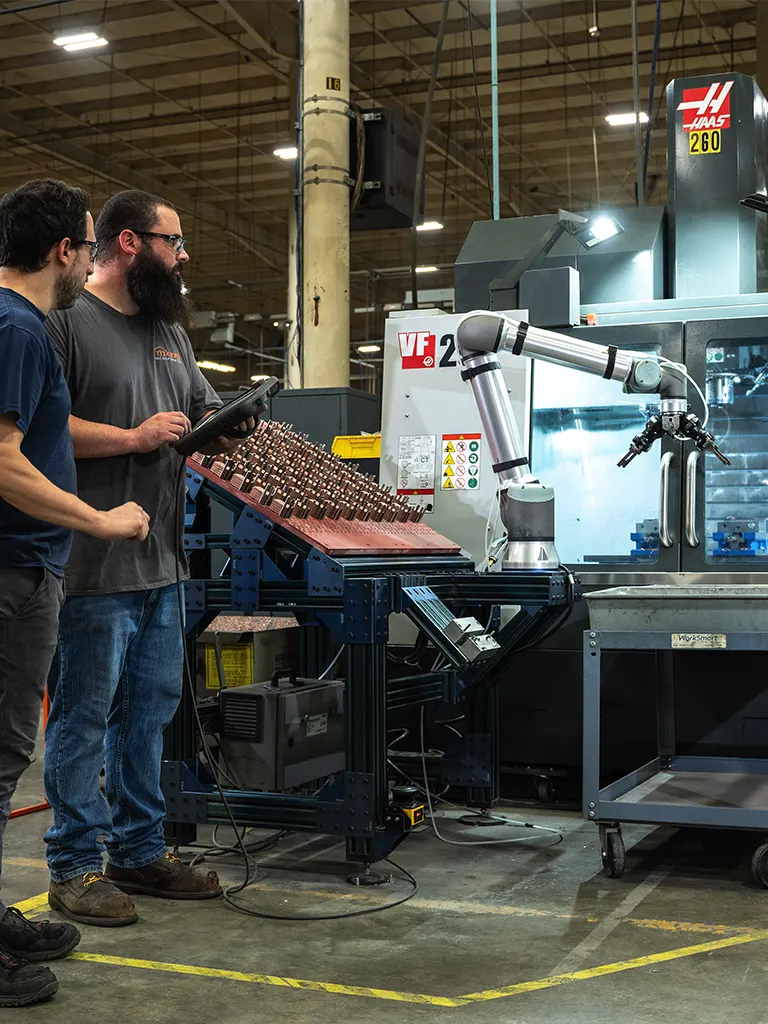
At Monti, CNC machining covers the supports, while punching handles barriers and polycarbonate windows in volume.
Any one of those parts looks minor on a bill of materials, yet together they decide whether the lineup ships.
Think of a finished assembly as four things stacked together: a copper conductor, the insulation around it, the hardware that fastens everything and the enclosure holding the lot. Pull any layer out and you no longer have a power-distribution assembly.
Why a Small Insulating Part Can Stall a Switchgear Build
A switchgear lineup with finished copper, formed steel and delivered breakers still cannot ship if one insulating barrier is missing. Everything else on the floor waits on the cheapest item in the assembly.
Teams order insulation last, which is why it ends up on the critical path. By the time a drawing goes final, the copper and steel have already gone out to quote. Buyers chase the insulating parts afterward, which leaves no slack when a grade turns out scarce. Monti hears the same story from buyers. Engineering released the design late, and the parts are needed in two to three weeks.
Raw material is the harder constraint. Data center demand has outrun what laminate manufacturers can produce, pushing sheet lead times past 18 weeks. A three-week request against an 18-week material lead time has nowhere to go.
Why Engineering and Procurement Should Weigh Insulation Earlier
Long equipment lead times have already changed how buyers sequence a project. Terrapin Construction Group puts 15kV medium-voltage switchgear at 52 to 80 weeks in 2026. Buyers once waited roughly 24 weeks for comparable equipment. At 38kV the range stretches to 78 to 104 weeks.
With that kind of runway, insulation can no longer wait on a late purchase order. Work the decision in this order instead:
- Pick the material and the grade.
- Design the part around what that material can do.
- Confirm availability of the sheet stock you just specified.
- Settle fabrication: who machines it, and to what tolerance.
- Agree on the quality checks and the documentation that comes with them.
- Plan the jump from prototype quantities to production volume.
Step six deserves its own question:
Can your insulation supplier scale when your switchgear production scales?
Plenty of distributors will sell you sheet, but fewer can machine a thousand finished barriers and hold tolerance. Ask it at the quote stage rather than at first production release.
Monti handles prototype quantities through full production. Standard lead times are three to six weeks. When quantity and material allow, Monti can expedite to one to five days.
A blanket order beats either route. Once an OEM locks a design, a release covering six to twelve months of demand changes the math. Monti can buy raw material ahead and build one to two months of parts at a time. Finished parts ship as the line needs them, which holds down the customer’s on-hand inventory. Of those six steps, material availability is the one customers skip most.
How to Design a GPO-3 Component for Manufacturing
A sheet of GPO-3 and a finished insulating component are two different purchases. The second one goes better when a machinist sees the drawing early. Cover these with the shop:
- Sheet utilization and part nesting, which drive scrap and unit cost
- Hole patterns and tolerances a machinist can hold through a long run
- Part geometry, including any feature that invites chipping or delamination
- Repeatability from the first piece to the five hundredth
- The gap between a prototype quantity and a production quantity
GPO-3 machines differently from steel or aluminum. The glass reinforcement wears tooling fast, which is why Monti pairs proprietary tooling with standard fixturing. On a typical part that holds ±.005″ on holes and ±.020″ feature to feature.
The most common mistake on a GPO-3 print is a thickness tolerance tighter than the raw stock carries. Sheet arrives with its own mill tolerance. Check it against the part tolerance at the drawing stage.
Monti machines GPO-3 into finished components and ships them ready to install.
For the customer, that means one drawing, one purchase order and one source accountable for the finished part.
One Supplier for More of the Electrical Assembly
A customer building power-distribution equipment usually needs five things made. Copper bus bars, machined insulation, sheet-metal components, plating or coating, plus the hardware and assembly that join them. Split those across five vendors and you get five quotes, five schedules and five sets of quality paperwork. Every handoff between them adds shipping cost and one more chance for something to go wrong.
Monti already pairs copper fabrication with plating, which removes one of those handoffs. Adding machined GPO-3 components removes another.
About 70% of Monti’s customers already buy both copper and insulation components. The practical payoff is one contact handling design, capacity, lead time and cost across every material.
As Electrical Infrastructure Grows, the Supply Chain Has to Grow With It
Data centers, grid modernization and industrial expansion keep pulling attention toward the equipment that distributes power. Copper conductors stay the most visible piece of that equipment, though safe power distribution depends on much more. Electrical insulation belongs in that equation, with GPO-3 carrying a good share of the load.
Monti supports electrical OEMs with fabricated copper and aluminum conductors, electrical insulation components and steel fabrication. One supplier across those materials means one team working on design, capacity, lead time and cost savings with you.
Send us a print for a quote on the part, the material and the lead time.
What can Monti do for you?