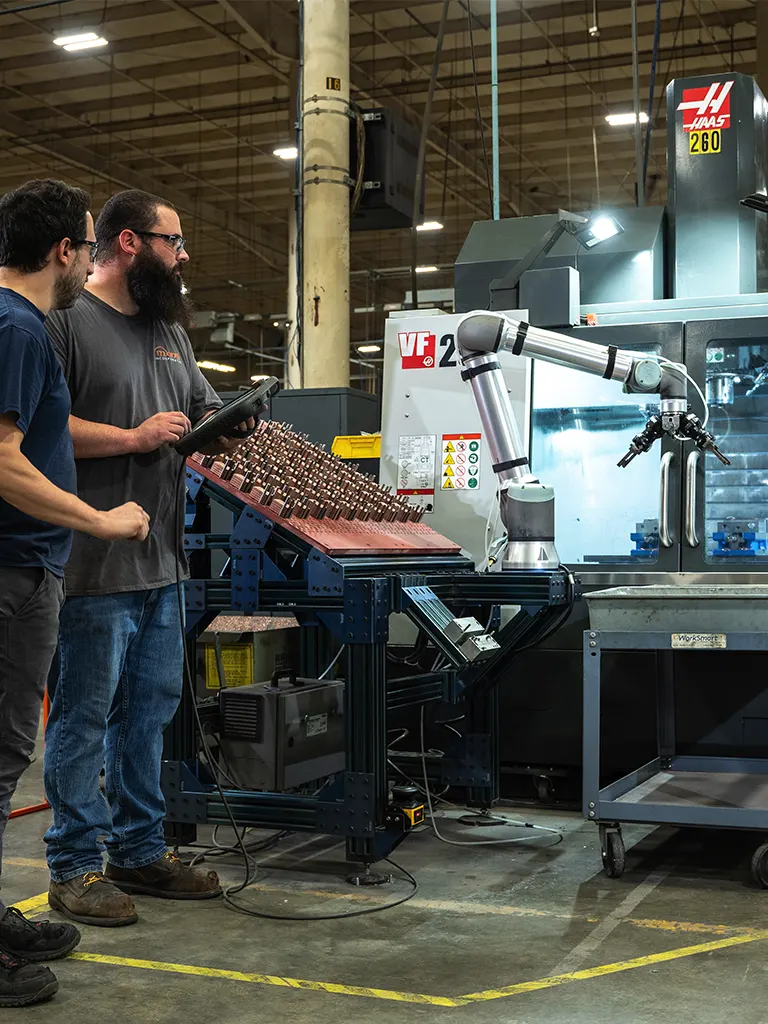
Quoting a hundred-line job used to take days here. Print the parts out, spread them across a desk, run every dimension through a spreadsheet of formulas, then key all of it into the ERP system a second time. But in July, that cumbersome process ended when Monti’s Cincinnati location went live on Paperless Parts, a quoting platform built for manufacturing shops. It reads a CAD model to calculate cycle times, and the finished quote moves into our ERP system.
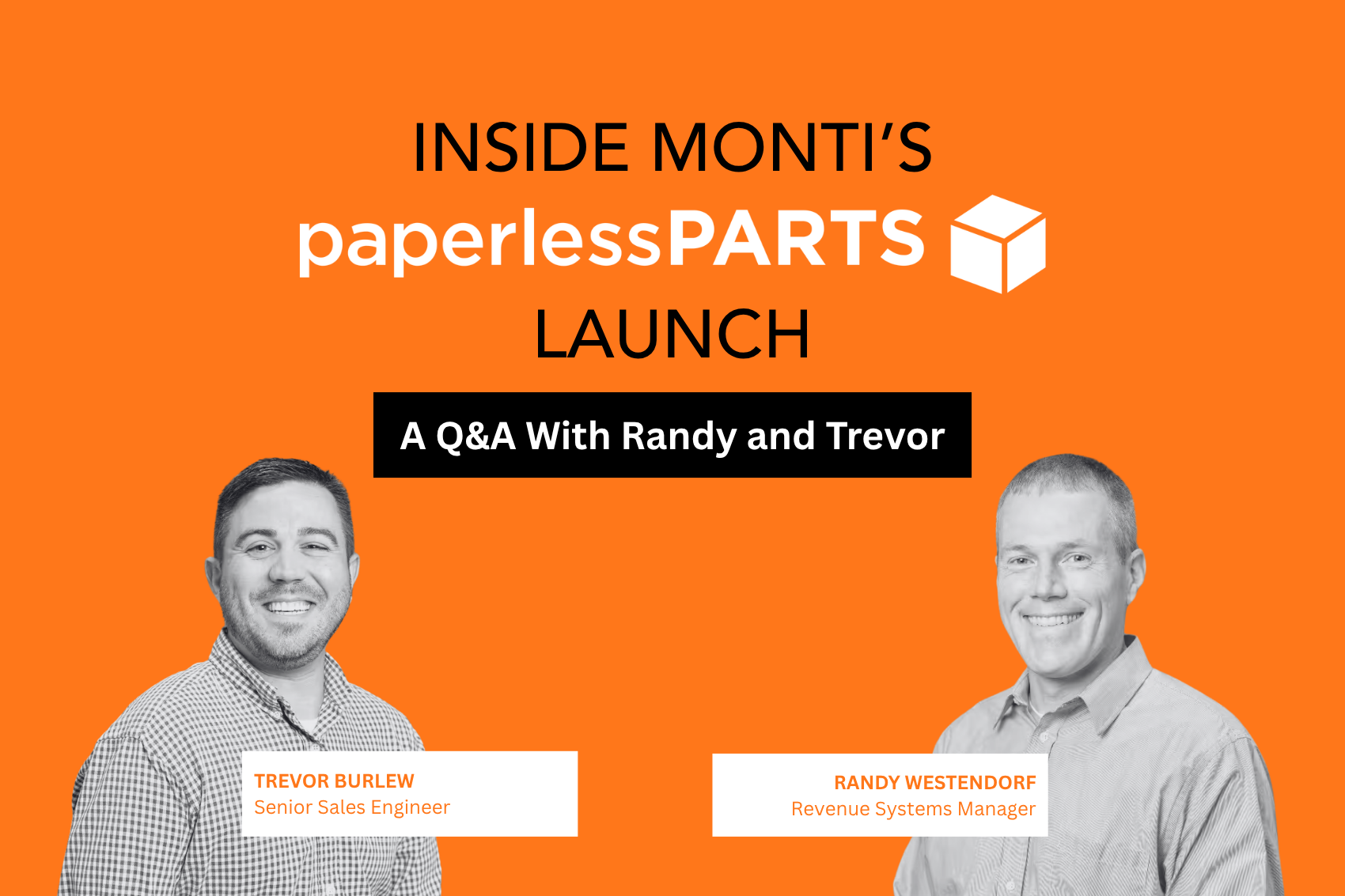
Recently, we sat down with Revenue Systems Manager Randy Westendorf and Senior Sales Engineer Trevor Burlew and asked them how the build and go-live went.
Answers have been edited for length and clarity.
How long have you been with Monti, and how does Paperless Parts fit into your day-to-day?
Randy: I’ve been here 10 years, and I’ve been estimating for 20. I’m not doing as much estimating right now — I’m doing more managing of the software — but it helps the sales engineers get more throughput on their quoting.
Trevor: I’ve been with Monti for 13 years. I’m in the day-to-day of quoting and customer information for managing the account. Paperless is going to let us focus more on the technical and commercial aspects of the quote as opposed to the administrative aspects, which gives us more time to make sure we’re developing the right solution for what the customer needs and less time on the quote setup itself. More speed to quote for us.
Before Paperless Parts, how was quoting handled? Walk us through it.
Trevor: The process was much more manual. We were still trying to maneuver from a paper-based company to a more paperless one, no pun intended. A lot of times we would print out quotes, organize them on our desk, and then everything had to be entered into our existing ERP manually, in a very one-off fashion, before it could be routed manually, in a one-off fashion, and then be quoted.
Randy: The overall process historically was very tedious. You’re typing numbers into a calculator here, but then you have to type them again over here. There was a lot of redundancy in the process, and it was necessary, because we never had a program that was all-inclusive for any one portion of the costing for our prices.
Was there a breaking point that sent you looking for something else?
Randy: We get hit up by estimating software companies frequently. Everybody’s trying to sell us a product. We had an elaborate spreadsheet that did all these calculations for us, and most people’s offer was, “Hey, we can do this on a web-based platform.” All it did was the same exact thing we already did. We’d have to type it in there and then type it in again in our ERP system.
The difference with Paperless Parts is the integration it has with our ERP. The quote and all the work that we do ends up transferring automatically. We sat down with them, talked about how everything would work, and it sounded like it was going to be advantageous to us because of that main ingredient other companies do not provide.
Trevor: As we continue to grow, we need processes that keep pace with the business we’re competing on. We can’t completely rely on manual processes, or on information being managed by different individuals the way it has been in the past. Paperless gives us a more centralized and consistent quoting workflow. It helps us handle more opportunities and gives customers better responsiveness.
What did getting it up and running look like?
Randy: For Trevor and me, it was a lot of work and a lot of learning. Their software is kind of a shell. It has certain functionality, but we still have to give it the formulas and tell it how it’s going to process everything. So that was a good seven or eight months of work for the two of us.
What’s great is that we had a two-day training, and we already have six employees entering and completing quotes. Once Trevor and I did all the work we did, it was a very small learning curve for the rest of the team, because the actions they take are similar to what we already did. They just get to cut out a whole bunch of steps and have a few more automated things going on.
Trevor: Monti works with a variety of parts, materials, and manufacturing processes, which is a little different from what Paperless had been integrating with in the past. So, the timeline mirrors the complexity of what we offer. Now that we’re rolling it out to the team, the platform is going to bring the RFQ information together in a more concise workflow and let us communicate with other departments to get quotes out faster.
Anything you’d do differently?
Randy: Having never built a software before, there was a huge learning curve for me in just trying to guide that. With experience, we could probably cut out a month or two. There are a couple of things Trevor and I discussed where maybe we should have gone one way from the start instead of another. But in the end, I think it’s as good as we could produce. Happy with the result.
Is it true you can just upload a CAD file and Paperless Parts tells you the measurements?
Randy: Historically, if we got models at the quote stage, we didn’t really care, because we couldn’t do anything with them. We’d read the print, type in dimensions, add up stuff. Now, when you get a model, there’s interrogation software within Paperless that evaluates what the flat pattern would be, how many holes are in there, what the surface area is. All these calculations we’d have to do manually within our spreadsheets, it’s doing automatically. When it pulls in that information, it’s automatically spitting out the times. We don’t even have to put anything in.
We still look at the print and make sure the notes and dimensions match what Paperless gives us. But if you have a model and a print in front of you and it’s pretty straightforward, you end up getting a line done in less than a minute compared to two or three. That seems insignificant, but when you’re quoting hundreds of parts a day, it adds up really fast.
So, where does the estimator’s judgment come in?
Trevor: It’s important to understand that Paperless Parts is a tool that supports the expertise of our team. It helps reduce the repetitive work and organize the information, and we’re still relying on the expertise and experience of the sales engineering team to review the outputs before our customers get a quote. We definitely want that understood. It’s a tool that helps us organize, and the personal touch and the expertise at Monti stay right where they are.
Has customer turnaround changed yet?
Randy: We’ve had a couple of emergency quotes come through, and we’ve been asked to turn those in Paperless rather than hand them to a sales engineer at one of our other locations. We’ve had some other opportunities turn a little quicker too. I think it’s the sales engineer’s propensity to want to use the product that’s helping with that. When an emergency comes by, in the past it was like, “Ugh, I have to quote all these parts really fast.” Now it’s just, “Okay, let’s go.”
One of our employees has such a good relationship with his customer that they give him blank POs. No prices on them at all, and tens of parts on every single one. He’s running them through Paperless now. Uploads everything, it spits out time, he turns it into a price, uploads it into our ERP, and generates all the work orders. Very quick turnaround on the work that gets presented to him.
What’s the Monti team’s reaction been?
Randy: Some of these quotes people were doing took days and days, because they were quoting a hundred-some-odd items. Now people are not dreading having to get a quote done. I could almost borderline say it was a morale booster for our department — not that we needed too much morale boosting around here!
Trevor: Right now, it’s about getting comfortable in the platform and building the steps into our day-to-day process. But you hear a lot of wows, or “oh cool, that’s neat,” when we find something new. Because of the size of the software, we’ve really only scratched the surface of some of the complex bulk quoting opportunities inside of it. As we learn more, it’s more like, “Hey, neat, let’s do this and do it faster this way.”
What would you say to another shop weighing the same switch?
Trevor: I would encourage it. Everything depends on the type of business you’re doing. We threw Paperless a curveball with the complexity we have, and that complexity is part of what makes us competitive. For a shop doing metal fabrication or bus bar punching or one main operation, I would say this would be a quick setup and it would be successful.
The team is great. They’re responsive. They came on site to evaluate what we had to do, came on site again to do the training, and added calls as we needed them throughout the weeks. We started with a single call a week and now we’re up to three. They give us the time we need based on the complexity we have. Overall, a good experience.
Anything we haven’t covered?
Trevor: We’re a week in, and we’re only live with a portion of the processes we do. They describe the stretch right after go-live as hyper care, and that period is going well so far. No major hiccups.
Randy: The platform is working very well and the Paperless team is very responsive to the needs we have. Things are going well.
Have a job that needs a number, or a hundred of them? Send Monti your prints and models. Bulk quoting is what Paperless Parts was built for, and our team is ready to handle whatever you need.