A bus bar plating callout that reads “silver plated” tells the shop almost nothing. It does not say how thick, where, or to which standard, so the joint you get is the joint the shop decided to give you. On a high-current bolted connection that has to stay low-resistance for the life of the gear, that gap is where field problems start.
Here is what a complete callout specifies and what Monti runs to meet each line. It is the fabrication and finishing the bar goes through before it reaches your dock follow after.
What a bus bar plating callout should specify
| Spec element | What to call out | What Monti runs |
|---|---|---|
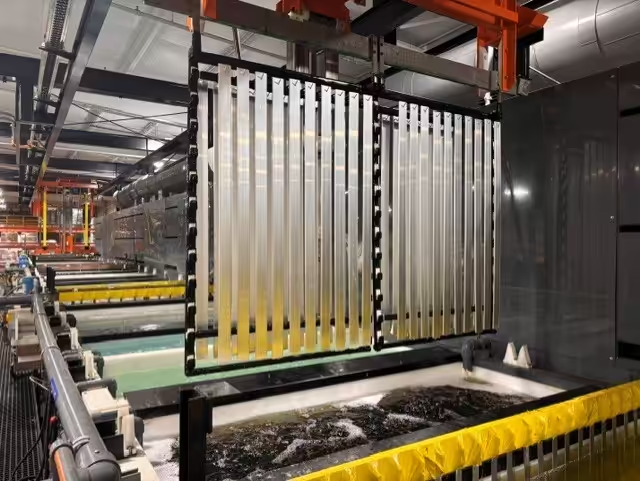
| Finish | Silver or tin, matched to current, environment, and mating surface | Silver or tin, all in-house through Plating Solutions* |
| Standard | ASTM B700 (silver), ASTM B545 (tin), with type, grade, and class | B700 Type I, Grade B, Class N; B545 class for tin |
| Thickness | A minimum on the functional surfaces, not a blanket spec | Our plating ranges from 50 to 2,000 µin based on the customer-defined thickness |
| Coverage | Full bar or localized to defined joint zones | Localized or full-bar, masked to the zones on your print |
* Plating Solutions is Monti’s in-house electroplating arm and is ISO-9001:2015 registered.
Plating is one step. Monti owns the whole bar.
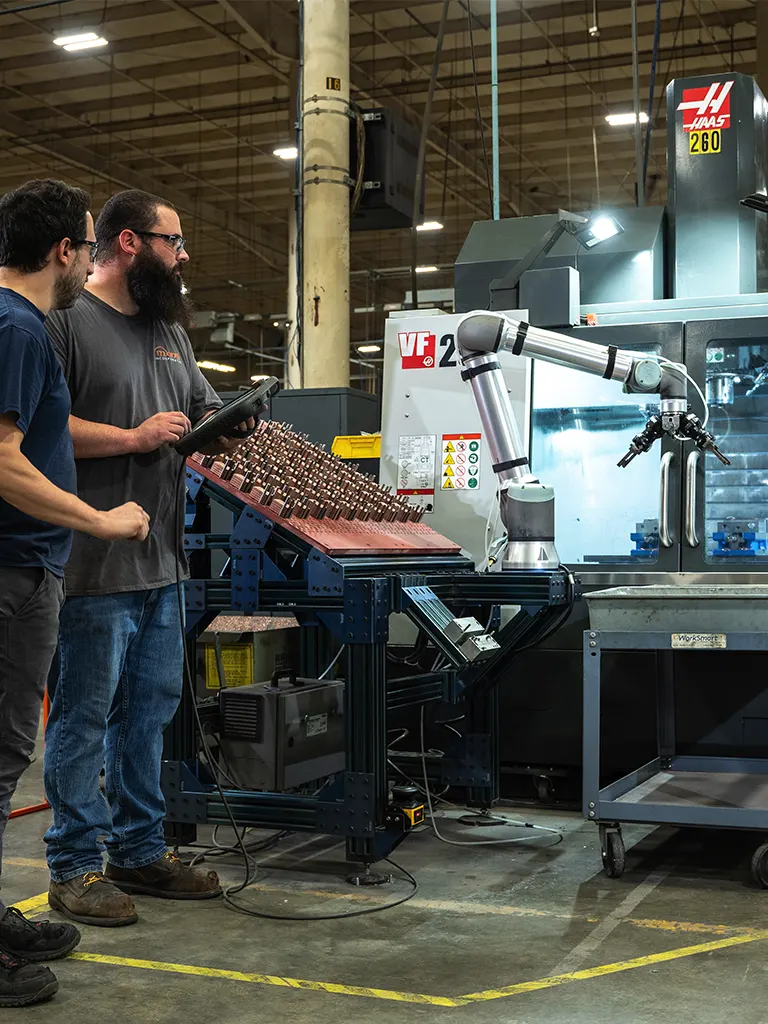
Most shops fabricate the copper and ship it out to a plater. Not us. Monti does the entire bar in-house, through a dedicated bus bar fabrication operation, which is why the plating spec gets held end to end. Here is what that covers for a bus bar program:
- A dedicated bus bar cell. Monti runs a dedicated bus bar punching and bending cell, so the forming and hole work that define a bar happen on tooling set up for exactly that, rather than getting squeezed onto general equipment between other jobs.
- Copper fabrication to print. We cut, machine, and form custom copper bus bar to your specification, from prototype quantities through production runs. Press brakes up to 250 ton with a 12-foot bed and CNC turret punching up to half-inch stock cover large and heavy-gauge bars, and wire EDM and 5-axis milling handle tight-tolerance features where a bar needs them.
- High-conductivity connections. Where a bar needs a brazed joint, our welders run MIG, TIG, and robotic welding, and use silver brazing for connections that have to carry current rather than only hold mechanically.
- Plating. Silver and tin through Plating Solutions, our own electroplating arm.
- Insulation coating. In-house epoxy, heat shrink, and plastisol coating for bus bar that needs insulation or arc suppression, applied to the same bar we fabricated and plated.
- Assembly and kitting. We combine the finished bar with the rest of your hardware into a subassembly or kit, so what arrives is ready to install rather than a box of loose parts to coordinate.
One bar can move through every one of those steps without leaving the company. That is the part a separate plater cannot offer, and it is the reason the thickness, coverage, and documentation on your drawing survive from raw copper to finished part.
How we verify and document it
A spec is only as good as the proof that the part met it. For every plated bus bar, Monti can supply:
- Thickness is verified by XRF and beta-backscatter technologies and recorded against your drawing minimum
- Adhesion testing per tape test, so the deposit holds through forming and service
- First-article documentation and certificates of conformance on request, plus PPAP Level III
- ISO-9001:2015 quality records that map to your incoming inspection, so the part clears your dock without a back-and-forth
Plating Solutions is itself ISO-9001:2015 registered, so the finish runs to a documented quality system rather than the judgment of a job shop down the road. Every Monti plant carries the same registration, which means a bus bar fabricated in Cincinnati or finished through Plating Solutions answers to one quality standard end to end.
Domestic copper, domestic finish
Switchgear and power distribution buyers are under real pressure to bring critical parts back to domestic suppliers, between tariff exposure, domestic-content requirements, and the lead-time risk of an overseas vendor that misses a date. Monti is a US manufacturer with five plants and an in-house material inventory, so we can source the copper, fabricate the bar, and finish it without a single step crossing a border. For a buyer building the internal case to re-source a bus bar program, that is a domestic supply chain you can document, certified to ISO-9001 at every stage.
Why this matters when the line is waiting
When fabrication lives at one shop and plating at another, the thickness, coverage, and documentation pass to a vendor who never saw your drawing notes and owns none of the original commitment. Turnaround stretches across two companies, and a thickness miss becomes a finger-pointing call between suppliers while your build sits.
Monti has run this work for over fifty years, supplying bus bar and electrical components to major switchgear and power OEMs. The copper, the plating, the epoxy, and the documentation stay with the company that made the bar. One drawing, one supplier, one part that arrives plated to print and ready to install.
That is the difference between a bus bar finished to your spec and one finished to whatever the cheapest outside line could justify.
Put your bus bar spec in front of a shop built for it
Send Monti the print. You will get one quote for the fabrication and the finish together, a confirmation that the plating spec fits your application, and a straight answer on the thickness, class, and documentation we hold before you commit a single part. One drawing, one supplier, one bar that arrives plated to print and ready to install.
Explore our custom copper machining and fabrication capabilities or request a quote and put your drawing in front of our team today.